

Confidentiality means your health information is handled privately, with sharing usually based on your consent. In England, you can raise concerns about a friend or relative with their GP, but the GP may not be able to discuss their care with you. Knowing how to discuss health concerns confidentially can help you decide what to share, with whom, and what support to ask for.
It’s understandable to want help while keeping personal details private. A health professional can listen to concerns from family members or carers, even when confidentiality limits what they can say in response.
This article explains who you might choose to tell, how confidential referrals work, and how decision-making capacity can affect information sharing across the UK.
Key Takeaways
- Weigh the relief of sharing a health concern against the privacy you want, and choose who you feel comfortable telling.
- Learn how a confidential referral can let you pass on concerns while respecting the other person’s privacy.
- Understand how consent and decision-making capacity shape what health professionals can share with family or carers.
- Find out what to expect from a private conversation with a health professional and how nurse-led wellbeing support may help.
How a confidential health support professional can help you choose whom to tell
A confidential health support professional can help you weigh the benefits and risks of sharing sensitive information. You might want a partner’s support with a mental health concern but prefer not to tell colleagues. Thinking about what you hope will change can clarify whether to disclose, who needs to know, and what you want kept private. You remain part of that decision.
Start by naming the people or groups you are considering. A professional can help you assess whether each person is likely to listen, respect your privacy, and offer useful support. At work, consider whether your manager handles personal information carefully. Your organisation’s accommodation, inclusion, and respectful workplace policies can also help you judge the setting.
Think about the practical purpose of sharing. Telling a trusted colleague may help you plan for times when illness affects work. Sharing with a relative may help you explain care or ask for support. You can tell one person but not another, or share only the details needed for the conversation. A professional can help you set those boundaries.
Confidentiality does not mean information is never shared between health professionals. According to UK Parliament, in England, the Health and Social Care (Safety and Quality) Act 2015 created a duty to share information for direct care, subject to certain circumstances. Your professional can discuss what that means for your care and what information may need to be shared with doctors involved in it.
If you are unsure, ask the professional how they protect your information and when they may need to share it. This can help you distinguish an appropriate disclosure for care from a possible breach before deciding what to share yourself.
If you think your health information was shared improperly, contact the organisation involved and ask what was shared, with whom, and why. Keep a note of your concern and use its complaints process if the response does not resolve it.
Confidential referrals and support services
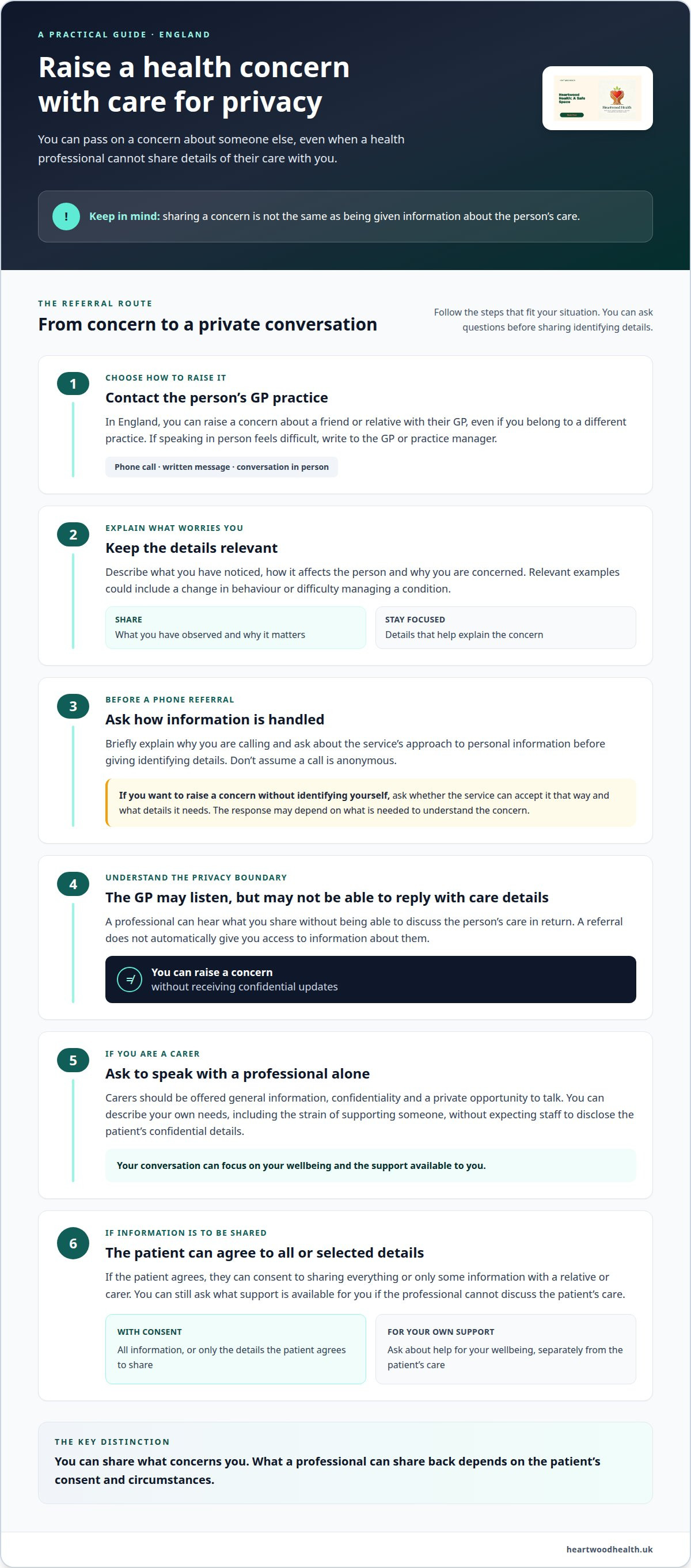
A referral passes a health concern to a service that may be able to help. It can come from you, a relative, a carer, or a professional. In England, you can raise concerns about a friend or relative with their GP, even if you belong to a different practice. You can write to the GP or practice manager if speaking in person feels difficult.
Sharing a concern is not the same as receiving information about the patient. A GP may listen to what you say but cannot necessarily discuss the person’s care in return. You can still explain what you have noticed, how it affects them, and why you are worried. Keep details relevant, such as a change in behaviour or difficulty managing a condition.
For a phone referral, briefly explain why you are calling and ask how the service handles personal information before giving identifying details. Don’t assume a call is anonymous. If you want to raise a concern without identifying yourself, ask whether the service can accept it that way and what details it needs. The response may depend on what information is needed to understand the concern.
Carers can also ask to speak with a professional alone. They should be offered general information and confidentiality when talking with a professional. This gives you space to describe your own needs, including the strain of supporting someone, without expecting staff to disclose the patient’s confidential details.
A referral does not automatically mean that information about the person will be shared with you. If the patient agrees, they can consent to sharing all or only some information with a carer or relative. You can ask what support is available for you, even if the professional cannot discuss the patient’s care. For a separate conversation about your own wellbeing, confidential nurse-led wellbeing support may help you explore your concerns.
A written message is another way to raise a concern about a family member or friend with their GP or practice manager. Carers speaking with a professional should be offered general information, a private opportunity to talk alone, and confidentiality during that conversation.
Confidentiality and adults with decision-making capacity
An adult who can make a decision about sharing personal information can usually decide who receives it. Consent may cover all details or only selected information, such as a diagnosis but not treatment discussions. According to UK Parliament, the Mental Capacity Act 2005 is relevant to decisions about mental capacity. Capacity is considered for the particular decision, rather than assumed from a diagnosis or a person’s circumstances.
Healthcare professionals should normally seek consent before sharing an adult’s confidential information with relatives or carers. You can explain who may receive information and what they can hear. For example, you might agree that a sister can know about appointment dates but not the details of a medical discussion. A professional should respect a capable adult’s refusal unless disclosure can be justified in the public interest.
Confidentiality does not prevent you from raising a concern. A doctor can listen to information from a friend or carer, even if they cannot share details in return. Professionals may rely on implied consent to share relevant information within a direct care team when the required conditions are met. They should seek explicit consent if the patient would be surprised by access or disclosure, unless doing so is not practicable.
A parent does not automatically have access to a teenager’s medical records simply because they are their parent. Access depends on the young person’s circumstances, their ability to make the relevant decision, and their consent.
You can ask a health professional about arranging a chaperone or interpreter for a confidential appointment. Explain what would help you feel comfortable or understand the conversation, and discuss arrangements before sharing sensitive details.
If an adult lacks capacity for a particular decision, professionals consider the circumstances and applicable decision-making processes. An advance decision can record refusal of specific medical treatment if the person later lacks capacity; an advance statement records wider preferences about future care. These documents serve different purposes, so clarify which reflects the person’s wishes about information sharing.
A capable adult’s refusal should not lead to services abandoning them.
GMC guidance states that most patients understand and expect relevant information to be shared within the direct care team to provide their care.
Can a health professional offer you a private consultation about a health concern?
You can ask for a private conversation about a personal or health concern. Explain what would help you speak comfortably, such as talking without a relative present or discussing a sensitive subject separately. Knowing how to discuss health concerns confidentially can make it easier to begin. Before you share details, a professional can explain the consultation’s purpose and how your information will be handled.
Before the appointment, decide what you most want help with. You might want to talk about anxiety affecting sleep, a change in your wellbeing, or how to raise a concern with someone close to you. You don’t need a perfect explanation. A few notes on what has changed and what support you hope for can help focus the conversation.
At the start, ask who may see the information, whether anything will be recorded, and what circumstances could mean it needs to be shared. If you’re considering how to discuss health concerns confidentially, these questions can clarify the boundaries before you share personal details. If you’d rather not answer something, say so and ask why it’s relevant.
A confidential consultation can give you space to talk through concerns and consider possible next steps. It is different from medical diagnosis or treatment. For example, a health support professional may help you organise your thoughts before speaking with your GP. If you need medical assessment, explain this so the conversation can focus on suitable support.
You can also ask for practical adjustments, such as an interpreter, a chaperone, or a particular way of communicating. Agreeing these details beforehand can help you focus on the concern itself.
If a confidential conversation would help you consider a wellbeing concern, arrange a private support conversation.
Heartwood Health: Confidential wellbeing and health support
Heartwood Health provides Confidential wellbeing and health support when you want space to talk through a concern and consider what support may help. Nurse-led wellbeing support can help you organise your thoughts, explore wellbeing questions, and prepare for discussions with others. You can also talk about what feels comfortable to share and what you would prefer to keep private.
This support offers wellbeing and health guidance. It does not provide medical diagnosis or treatment or prescribe medication. If you want a calm, confidential conversation rather than a diagnosis, it may be a helpful next step.
Contact Heartwood Health to ask a question or discuss the support you’re looking for.
Take your next step at your own pace
You don’t need a complete plan before taking the next step. Consider what would make it manageable, whether that means writing down one question or choosing a suitable time to talk. Knowing how to discuss health concerns confidentially can help you approach that step with greater clarity.
Heartwood Health welcomes your questions and suggestions about what would make support feel more comfortable. Your priorities can guide the conversation.
If you’d like to get in touch, contact Heartwood Health for support. Take the next step when you feel ready.
Frequently asked questions
What is confidentiality?
Confidentiality means your health information should be handled carefully and used appropriately. In practice, ask how a service will contact you, especially if someone else might see your voicemail, email, or post. You can also ask who can access your notes and how to correct information you believe is inaccurate. These details can help you decide what feels safe to share.
When can a doctor share my health information without my consent?
A doctor may share your information when the law requires it or disclosure is justified to protect people from serious harm. If you are concerned about a particular disclosure, ask what information was shared, with whom, and why. You can request the explanation in writing to keep a clear record of the decision and raise any remaining concerns.


