

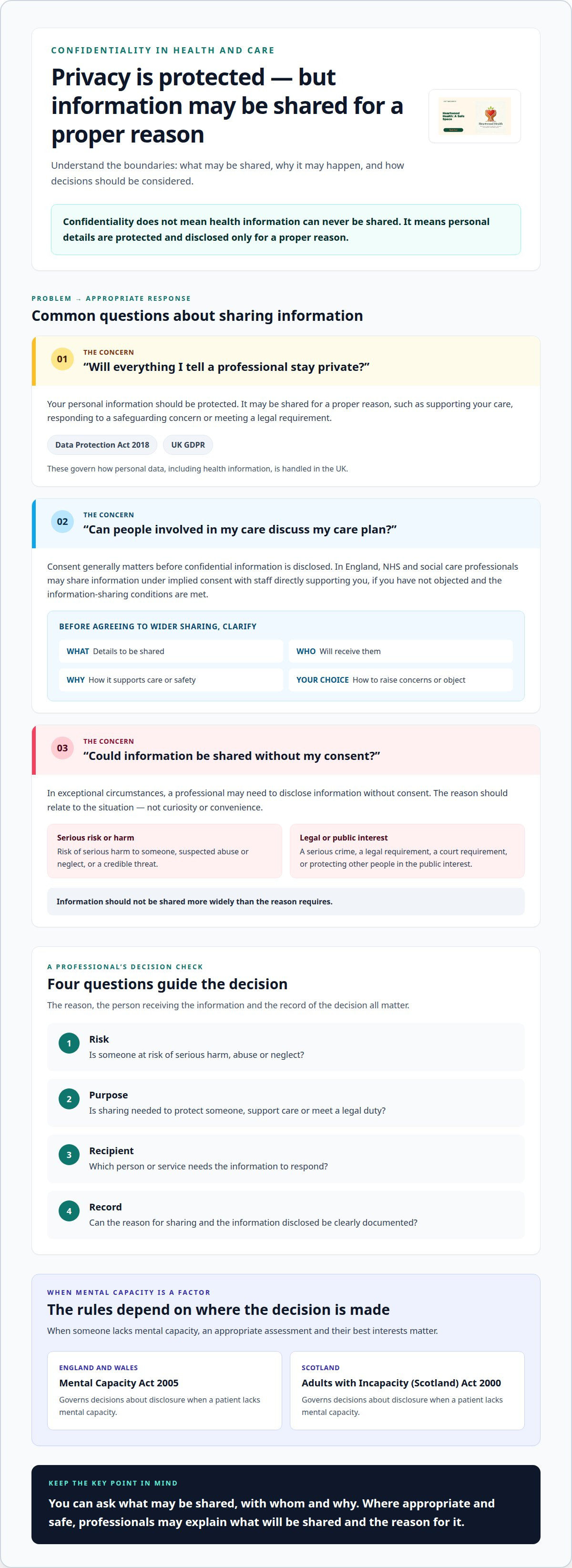
Confidentiality does not mean health information can never be shared. It means your personal details are protected and disclosed only for a proper reason, such as supporting your care, responding to a safeguarding concern or meeting a legal requirement. Confidential wellbeing and health support should make clear what may be shared and why.
It’s understandable to want control over who knows about your health, and the Data Protection Act 2018 and UK GDPR govern how personal data, including health information, is handled in the UK, according to The National Archives; consent matters too, although there can be exceptions when someone may be at risk or information must be disclosed.
This guide explains what confidentiality means in practice, when professionals may share information and how consent can shape those decisions. It covers safeguarding exceptions too, so you can feel prepared to discuss your concerns and understand how the information you share may be used.
Key Takeaways
- Understand how UK data protection law applies to personal and health information.
- Learn what consent can mean when professionals share information to support your care.
- Recognise why information may sometimes be shared without consent, including safeguarding concerns.
- Find out how decisions about sharing information may differ when someone lacks mental capacity.
What is Confidentiality in Health and Social Care?
Confidentiality means protecting personal information shared during care, from health details to family circumstances. In the UK, the Data Protection Act 2018 and UK GDPR govern the collection, storage and processing of personal data, including health information, according to The National Archives.
Confidentiality means understanding who may see your information, how it is handled and when it could be shared. It supports respectful care, but does not mean information can never be disclosed.
Meaning and scope of confidentiality
In care, confidentiality means protecting information a person shares or that is recorded about them. It covers conversations, written notes and digital records, including details about mental health, family life and care needs.
You can speak confidentially with a GP or health professional in the UK. They should respect your privacy and explain that information may be shared for a proper reason, such as a serious safety concern or a legal requirement.
Trust, dignity and privacy
Confidentiality can make it easier to discuss personal concerns without feeling that anyone can access your information without a reason. For example, someone may feel more comfortable telling a GP about anxiety or a sensitive health concern when their privacy is respected.
Young people can ask health professionals about confidential sexual health or mental health support, including what may be shared. Mental health helplines and online services offer other ways to seek help, but their confidentiality arrangements and exceptions may differ.
Confidentiality across care services
Community care may involve several people, such as a GP, social care worker and specialist. Confidentiality applies across these services: information should be shared for a clear care-related reason, not simply because someone works for the same organisation.
Confidential wellbeing and health support can help young people understand what support is available and how to approach services. Care workers should receive regular training on confidentiality policies and changes to legislation or good practice, so they know how to handle sensitive discussions.
Secure handling of care records
Secure handling means protecting care records when they are accessed, stored, used or shared. The Data Protection Act 2018 and UK GDPR apply to both digital and paper information, so a care record should be available only to people with a proper reason to use it.
For urgent or emergency health support, contact emergency services or an urgent health service. A professional may need to share information to address an immediate risk and, when appropriate, explain what was shared and why.
When professionals can breach confidentiality
Confidentiality does not prevent all information sharing. Professionals may disclose someone’s details without consent when there is a serious risk of harm to them or another person, suspected abuse, a serious crime or a legal requirement. The reason should relate to the situation, not curiosity or convenience.
Sharing may also be justified in the public interest, to protect other people, or when required by a court or law. For example, a professional may need to pass on information about a credible threat. Policies help care teams decide what is necessary, who needs to know and how to record the decision. Information should not be shared more widely than the reason requires.
When deciding whether to disclose information, professionals consider:
- The risk: Is someone at risk of serious harm, abuse or neglect?
- The purpose: Is sharing needed to protect someone, support care or meet a legal duty?
- The recipient: Which person or service needs the information to respond?
- The record: Can the reason for sharing and the information disclosed be clearly documented?
Mental capacity can affect decisions about disclosure. According to The National Archives, in England and Wales, decisions about disclosure when a patient lacks mental capacity are governed by the Mental Capacity Act 2005. In Scotland, decisions about disclosure when a patient lacks mental capacity are governed by the Adults with Incapacity (Scotland) Act 2000, according to The National Archives. In these situations, an appropriate assessment and the person’s best interests matter.
Where it’s appropriate and safe, professionals may explain what will be shared and why. If these boundaries feel difficult to discuss, you can talk through your wellbeing concerns in a supportive setting.
Consent forms and sharing care plans
Consent helps you decide how personal information is shared beyond what is needed for your care. The Common Law Duty of Confidentiality generally requires consent before confidential information is disclosed, except in exceptional circumstances. A consent form can record your decision, but should explain what information may be shared, with whom and for what purpose.
For a care plan, you might agree that your GP and social care worker can discuss your support needs. In England, NHS and social care professionals may share information under implied consent with staff directly supporting you, if you have not objected and the information-sharing conditions are met. Sharing information for care is important, alongside protecting confidentiality.
Before agreeing to wider information sharing, clarify these points with the professional:
- What: Which details from your record or care plan will be shared?
- Who: Which professionals or services will receive them?
- Why: How will the information support your care or safety?
- Your choice: How can you raise concerns or object to a proposed use?
Specific permission is likely to be needed if a professional wants to access your information for a reason beyond providing care, treatment or another service. To give consent, a person must have mental capacity for that decision. If capacity is in question, an appropriate assessment should inform decisions about disclosure.
Consent also matters when relatives and carers are involved. Professionals can listen to a carer’s concerns without permission to discuss your care or treatment with them. They generally need your agreement before sharing details about you. A nearest relative does not usually have a right to confidential information simply because of that relationship. Before deciding, ask what a form covers and raise any concerns about the people or purposes named.
Exceptions to confidentiality for safeguarding
Safeguarding may require a professional to disclose information without consent when someone could face serious harm. Examples include suspected abuse or neglect, a risk that a person may harm themselves, or a threat to another young person. The decision should focus on the specific circumstances and the protection needed.
For a young person, CAMHS may need to inform social care about concerns involving neglect, abuse, serious harm or harm to someone else. When safe and appropriate, professionals should explain what they plan to share, who will receive it and why. They may try to speak with the young person and their carers first.
In a safeguarding decision, care professionals consider:
- The concern: What has happened, and who may be at risk?
- The purpose: What action could protect the person or others?
- The information: What details does the safeguarding team need to respond?
- The record: How will the reason for sharing be documented?
Capacity can affect a person’s ability to decide whether to disclose information. If someone cannot consent, professionals should consider their circumstances and best interests, as well as any immediate safety concerns. A safeguarding disclosure is not permission to share every detail of someone’s care history. The information passed on should relate to the risk and the action needed.
For service users, it can help to ask what will happen next and who will be involved. A professional may not be able to keep a serious safeguarding concern private, but should explain the limits as clearly as possible. If you’re unsure how to talk about a wellbeing concern, speak with a nurse-led support professional.
Heartwood Health: Confidential wellbeing and health support
Heartwood Health offers confidential, nurse-led wellbeing and health support if you want space to discuss a concern and consider what might help. A conversation with a nurse can help you make sense of wellbeing questions and think through possible next steps, with care taken in handling personal information.
This support is not medical diagnosis or treatment, and it is not a replacement for urgent or emergency care. If you are unsure what kind of help would suit your situation, you can ask questions and explain what you are looking for before deciding how to proceed.
If you’d like a supportive conversation about your wellbeing, contact Heartwood Health.
Take a calm next step with your wellbeing
Understanding confidentiality can make it easier to talk about what is weighing on you. Start with the concern that feels most manageable, then ask how your information will be used and what support may help. You do not need to have everything worked out before starting a conversation.
For confidential wellbeing and health support focused on wellbeing, Heartwood Health offers nurse-led support. Its team brings health and wellbeing knowledge to conversations, helping you explore your concerns and consider possible next steps. This support is not medical diagnosis or treatment.
If you’re ready to talk, or would simply like to ask a question, contact Heartwood Health. Take things at your own pace; a small first conversation can help you feel clearer about what you need.
Frequently asked questions
What is confidentiality?
Confidentiality governs who can access or use your information, not just whether someone repeats it. The Caldicott Principles say access should be limited to people with a strict need to know, and only the minimum necessary information should be used. For example, a staff member not involved in your care should not look through your record without a legitimate reason.
What are the legal parameters for confidentiality in care?
Alongside data protection requirements, the Human Rights Act 1998 protects respect for private and family life, including personal information. The Common Law Duty of Confidentiality generally requires consent before disclosure, subject to exceptional circumstances. The Caldicott Principles guide decisions in health and care settings, including limiting access and sharing to what is needed. Together, these protections shape how professionals handle your information.
What confidential health support services are available in the UK?
You can seek confidential help through a GP practice, NHS mental health services, sexual health services, helplines or online support. Each option serves different needs: a GP can discuss health concerns, while a helpline may offer an initial conversation. Nurse-led wellbeing support can help you talk through wellbeing questions. Choose the option that suits the support you need.
What are the confidentiality rules for health services in England, Scotland, Wales and Northern Ireland?
Shared privacy principles apply across the UK, with additional guidance in each nation. Scotland has the NHS Scotland Code of Practice on protecting patients’ confidentiality, while Wales has a Confidentiality Code of Practice for Health and Social Care. In Northern Ireland, the Department of Health provides confidentiality guidance. These frameworks help services put confidentiality into practice within their care systems.
When can a health professional share confidential information without consent?
A professional’s decision should reflect the specific circumstances, not be treated as blanket permission to share your record. You can ask which details were disclosed, who received them and what the disclosure was intended to support. When safe and appropriate, the professional should explain the decision and record the reasons and information shared.


