

You can use nurse support alongside an employee assistance programme while continuing to see a counsellor. Each offers a different space to discuss wellbeing concerns, so you don’t have to choose between them.
It’s understandable to want clarity before sharing personal information, particularly when balancing demanding care work with your own health needs. This article explains how to access additional support and what to consider about confidentiality and waiting times, helping you decide whether another supportive conversation feels right for you.
Key Takeaways
- You can explore nurse-led support alongside counselling, with each providing a different space to discuss wellbeing concerns.
- Understanding how confidentiality works can help you feel more informed about using workplace support.
- Access routes and appointment waiting times depend on how support is arranged and delivered.
- For care workers, an EAP can sit within a wider approach to workplace wellbeing and support.
Can employees use the service if they are already seeing a counsellor or other mental health professional?
Yes. Nurse support alongside an employee assistance programme can complement counselling, so you don’t have to stop one form of support to use another. Each conversation can serve a different purpose. Counselling, for example, may help you explore emotional distress, while a nurse can discuss wellbeing concerns such as sleep difficulties affecting your shifts.
Confidential support can also help you consider personal and work concerns together. You might discuss how caring responsibilities affect your energy at work, or how workplace pressure affects your wellbeing at home. Sharing relevant context helps keep the conversation focused on what matters to you. You don’t need to repeat every detail of counselling sessions.
An EAP may not cover every health concern or provide the nurse-led wellbeing guidance you’re looking for. It isn’t a substitute for medical diagnosis or treatment. If you’re already receiving care, keep that support in place and use additional guidance to complement it, rather than expecting one service to meet every need.
Confidential counselling, emotional support and peer support are different. Counselling offers a private space to explore your feelings with a professional; peer support may help you feel understood through shared experience. Before sharing sensitive information, ask how the service handles notes, who may see them and how it responds to serious safety concerns. A risk assessment can help identify immediate needs and suitable next steps.
A practical first step is to explain that you’re already seeing a counsellor and describe the concern you’d like to discuss. You could focus on a physical wellbeing question, stress linked to a particular shift pattern, or how work and personal pressures overlap. This context helps keep the conversation relevant and clarify how the support can complement your existing care.
Barriers to EAP awareness, trust and uptake
An EAP can be available yet still feel difficult to use. A care worker finishing a late shift, for example, may not know where to find the access details or which concerns the programme can help with. If the information is in an induction pack that staff rarely revisit, the next step may not be clear when pressure builds.
Trust matters too. You may worry that discussing anxiety, debt or a workplace conflict could affect how managers see you. Clear explanations of confidentiality can help address that concern. Organisations should explain what stays private, what information may be shared and how serious safety concerns are handled. Staff need these details before deciding whether to speak.
Practical access can affect whether people use support. A worker who shares a phone or has little privacy during a shift may find a helpline difficult to use. Someone might prefer to read the service information first, then choose a suitable time and place to make contact. Simple, repeated reminders can keep the access route visible without pressuring anyone to disclose personal details.
Workplace culture matters as well. If managers mention support only after a difficult incident, employees may assume the EAP is only for crises. Including it regularly in staff briefings, welcome materials and wellbeing conversations can show that it’s also there for concerns such as sleep, family strain or stress at work. Managers should never ask employees to explain private circumstances in front of colleagues.
Turnover can make awareness harder to maintain, especially when new starters miss key information or experienced staff leave before sharing practical knowledge. An organisation can reduce this gap by assigning responsibility for keeping access details current and including them in each new starter’s introduction. A short, plain-language explanation should cover how to access support and what confidentiality means. If you would value another private space to discuss wellbeing, Confidential wellbeing and health support can be a gentle next step.
Employee access and appointment waiting times
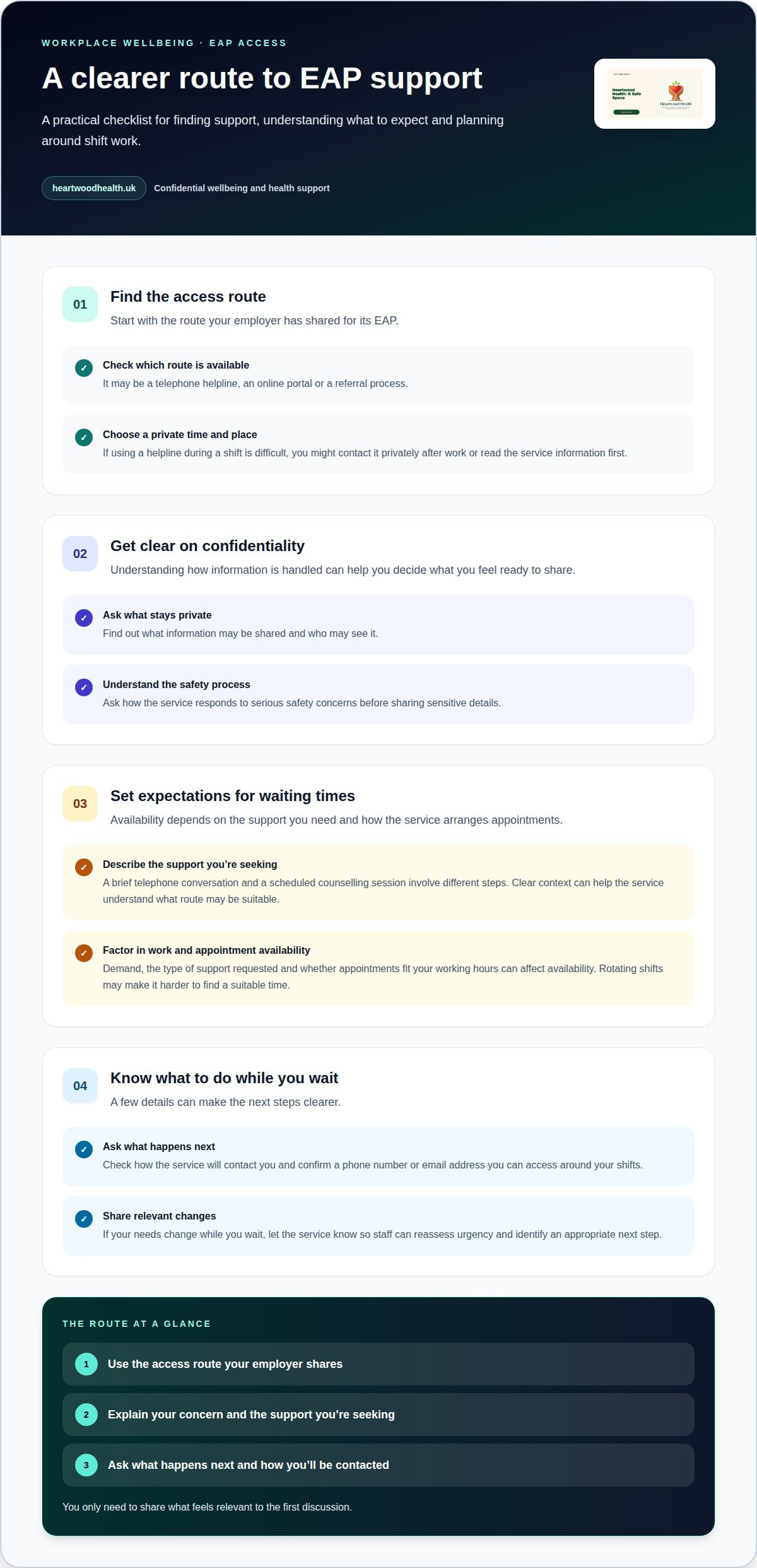
Start by using the access route your employer shares for its EAP. This might be a telephone helpline, online portal or referral process. For example, a care worker could contact the helpline privately after a shift, then follow the instructions for arranging further support. The route depends on how the organisation has set up its programme.
Waiting times depend on the support you need and how the service arranges appointments. A brief telephone conversation and a scheduled counselling session involve different steps. Demand, the type of support requested and whether appointments fit your working hours can also affect availability. A rotating shift pattern may make it harder to find a suitable time.
When you make contact, describe your concern and the support you’re seeking. You might explain that anxiety is affecting your sleep or that work pressure is making daily tasks harder to manage. Clear information helps the service understand whether you need an initial conversation, counselling or another route. You only need to share what feels relevant to that first discussion.
If you’re waiting for an appointment, ask what happens next and how the service will contact you. Confirm which phone number or email address is suitable, especially if you can’t answer during a shift. If your needs change while you wait, let the service know so staff can reassess the urgency and identify an appropriate next step.
For employers, accessible support means more than making a helpline available. Staff need clear instructions, private ways to make contact and appointment options that take shift work into account. Managers can build awareness by explaining the access process during induction and repeating it in staff communications. This can make support easier to find before mental strain contributes to absence. A clear route also helps employees know what to expect, rather than relying on colleagues for incomplete information.
Employee assistance programmes for care workers
For care workers, an EAP can offer confidential support for emotional, practical and clinical concerns. Adding workplace nurse support can extend the guidance available for health and wellbeing questions.
Nurse support and EAP differences
Workplace nurse support focuses on health and wellbeing questions, such as fatigue, work-related strain or health education. A care-sector EAP can offer confidential, 24/7 access to emotional, practical and clinical support. Nurse support can add tailored health guidance, while counselling remains focused on emotional care. Look at each service’s scope and referral route to understand which conversation fits your needs.
Rules for occupational health nursing and EAPs
In the UK, employers aren’t required to provide EAP benefits, so they decide whether to offer them. Occupational health nursing must stay within its professional scope, and services should explain confidentiality boundaries and how they respond to safety concerns. Employers can clarify these boundaries in staff information, including whether the EAP offers counselling, practical guidance or clinical support. This helps employees understand what each route covers.
Benefits of combining nurse support and EAPs
Using both services gives employees distinct routes for different concerns. Someone worried about stress affecting sleep might seek nurse-led guidance, then use EAP counselling for emotional support. The services can connect workplace wellbeing conversations with mental health support without treating them as interchangeable. For care teams, clear access to both routes can strengthen support around demanding shifts and personal pressures.
Arranging nurse support alongside an EAP
A provider can work with an employer to set out access routes, service boundaries and referral steps. Occupational health nurses can refer or signpost employees to an EAP through an agreed pathway. Employers can review service use, appointment waiting times, staff feedback and absence patterns together to understand effectiveness. These indicators can show where access works well and where communication or appointment arrangements need attention.
Heartwood Health: Confidential nurse-led wellbeing & health support
Heartwood Health provides confidential, nurse-led wellbeing and health support that can sit alongside an EAP or counselling. It may suit you if you’d value a separate conversation about health questions, work pressures or changes affecting your wellbeing, while continuing with the support you already receive.
A nurse-led conversation can help you explore what’s concerning you and consider practical next steps. It complements other support rather than replacing counselling, and it isn’t medical diagnosis or treatment. You can share the context that feels relevant and discuss what guidance would be useful.
If you’d like to explore whether confidential, nurse-led support feels right for you, contact Heartwood Health.
Choose a next step that feels right for you
Support works best when it fits the concern you want to discuss and feels manageable alongside your existing care. Nurse support alongside an employee assistance programme gives you another route to explore wellbeing questions without replacing counselling or other support already in place.
If you’re unsure where to begin, think about what you’d like help with first. It could be a health concern affecting work, a personal pressure that’s becoming harder to carry, or simply a need to talk through possible next steps. Share only the context that feels relevant to the conversation.
Heartwood Health’s team provides confidential, nurse-led wellbeing and health support as you consider what may help. A conversation can offer a calm way to explore whether this kind of support suits your needs.
Contact Heartwood Health about nurse support when you’re ready to take that next step. You deserve support that meets you with care and helps you move forward at your own pace.
Frequently Asked Questions
How long will employees have to wait for appointments?
There isn’t one waiting time for every appointment. Timing depends on the support requested, appointment availability and how well the available times fit your work pattern. A rotating care shift, for example, may limit when you can speak privately. When arranging an appointment, explain your availability and ask what happens next if the first option doesn’t suit.
What happens when employees first contact the service?
You’ll usually start by explaining what you’d like help with and how to contact you safely. You might mention work-related stress, a health worry affecting your routine or support you’re already receiving. The first conversation helps identify the guidance you’re looking for and a relevant support route. Keep your explanation focused on the concern you want to discuss.
What is an EAP?
An EAP is an employee assistance programme that provides workplace wellbeing support. It gives employees a way to seek help with work-related or personal concerns. For instance, you might want support with a difficult situation affecting your wellbeing. The acronym describes the type of workplace service; the support and access arrangements depend on the programme your employer provides.
What is an Employee Assistance Programme?
Employee Assistance Programme is the full phrase behind the initials EAP. You may see either term in staff information, an induction pack or workplace communications. The name alone doesn’t tell you how to access the service or which kinds of help it includes. Those details come from the particular programme your employer has arranged, so look for its contact route and service description.
What nurse support services are available alongside an employee assistance programme in the UK?
Confidential, nurse-led wellbeing and health support can complement an employee assistance programme. It offers a separate space to discuss health questions, wellbeing or how personal concerns affect work. Heartwood Health provides this support for individuals and businesses, including fully remote online sessions. It is supportive, not medical diagnosis or treatment, and can sit alongside other care you already receive.
How is employee confidentiality protected when using workplace nurses and an employee assistance programme?
Before sharing sensitive details, ask how the service handles your information and what, if anything, may be shared with your employer. You can ask who can access notes, how information is used and what happens if a serious safety concern arises. These questions help you understand the confidentiality arrangements before a conversation. Don’t assume every workplace nurse and EAP follows the same processes.


