

Workplace wellbeing support with an EAP can complement existing mental health care, but it does not replace ongoing therapy, clinical care or specialist support.
If you already see a counsellor or another mental health professional, you may wonder whether using an EAP will duplicate or complicate your support. Understanding the EAP’s purpose can help you decide how short-term counselling, practical guidance and other resources might fit alongside your current care.
This guide explains what an Employee Assistance Programme offers, how it differs from ongoing care, and what to consider when using both, including confidentiality and the EAP’s role in workplace wellbeing.
Key Takeaways
- You can use an EAP for short-term support while continuing care from your counsellor or mental health professional.
- Look at how EAP support fits your needs, including the practical advice and resources it can offer.
- Keep ongoing therapy, clinical treatment or specialist care in place; an EAP is not designed to replace it.
- For workplace wellbeing, consider how EAP support can complement existing HR processes and occupational health policies.
Can employees use the service if they are already seeing a counsellor or other mental health professional?
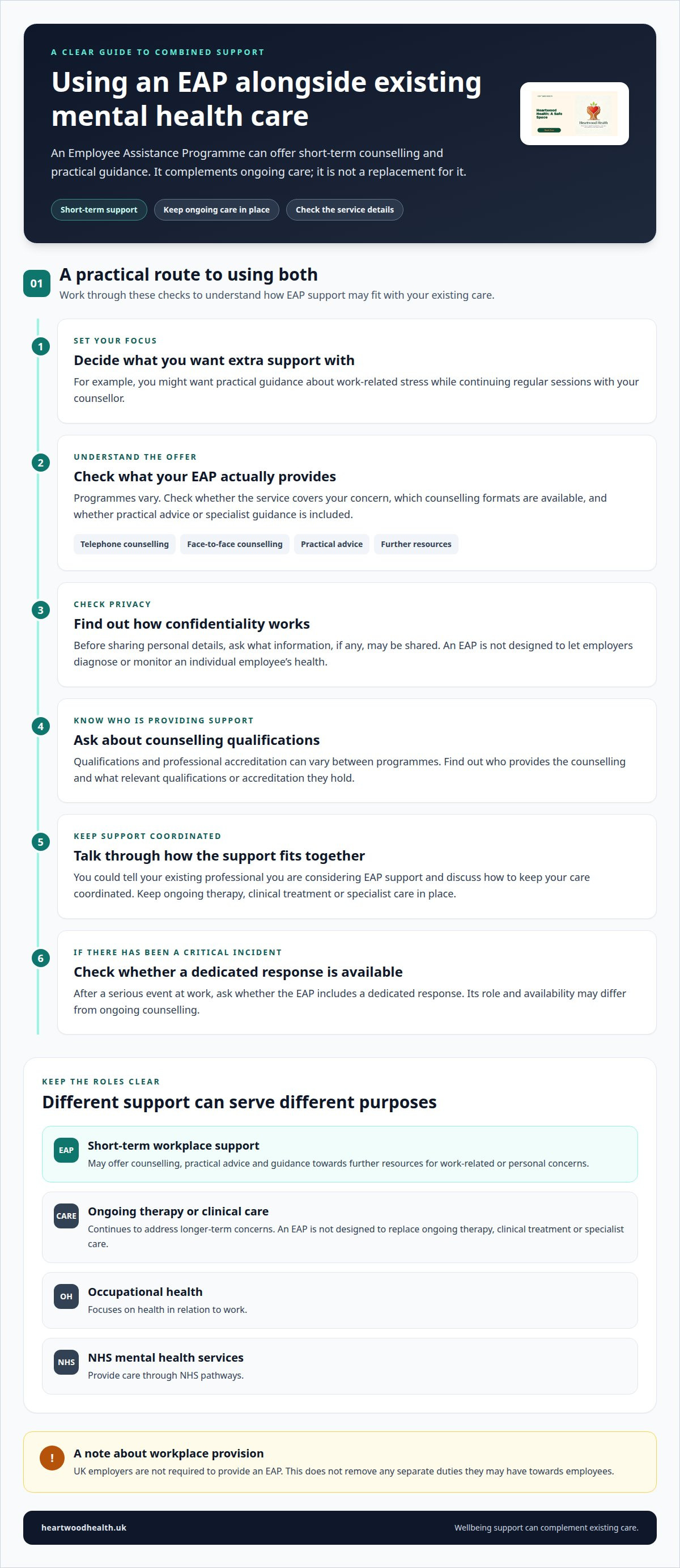
Yes. You can use an Employee Assistance Programme (EAP) while seeing a counsellor or another mental health professional. EAP counselling is generally short term, offering a separate space to discuss immediate concerns without replacing ongoing care.
An EAP is intended to support early intervention. For example, you might seek practical guidance about work-related stress while continuing regular sessions with your counsellor. The two forms of support need not be exclusive, but it helps to understand what each is addressing. You could tell your existing professional that you are considering EAP support and discuss how to keep your care coordinated.
Confidentiality matters. An EAP is not designed to let employers diagnose or monitor an employee’s individual health. Before speaking with the service, find out how it explains confidentiality and what information, if any, may be shared. This can help you decide what feels comfortable to discuss, whether it is workplace pressure or a personal concern affecting your wellbeing.
Counsellor qualifications and accreditation can vary between programmes. Find out who provides counselling, what relevant qualifications or professional accreditation they hold, and whether the service suits your needs. This helps you understand what support is available instead of assuming every EAP offers the same service.
After a critical incident, such as a serious event at work, find out whether the EAP includes a dedicated response. Its role and availability may differ from ongoing counselling. If you already receive mental health support, consider how an initial conversation could fit alongside your existing plan.
UK employers are not required to provide an EAP. This does not remove any separate duties they may have towards employees. EAP arrangements also vary: workforce size, service scope and access methods can shape what is included.
What is an Employee Assistance Programme?
An Employee Assistance Programme (EAP) is an employer-funded benefit that offers confidential support for personal and work-related concerns. For employees, workplace wellbeing support with an EAP can include counselling, practical advice and guidance towards further resources. Someone managing pressure at work, for example, might seek help identifying a manageable next step.
Programmes commonly provide short-term counselling by telephone or face to face, alongside expert guidance. What is available depends on the employer’s arrangement with its providers. Check the programme information to see whether it covers your concern, which formats it offers and whether a specialist can help.
Access instructions should explain how to make contact, such as calling a helpline or using an employee portal. Waiting times depend on the provider’s arrangements and capacity. Find out how to book an appointment and what options are available if you need guidance before a session.
Employees can follow the access route shared by their employer and ask about confidentiality before discussing personal details. An EAP is not designed to let employers diagnose or monitor an individual’s health. Clear privacy information helps employees understand how their details are handled.
Support for an employee’s immediate family depends on the programme’s eligibility rules. Some arrangements may accept family referrals, while others focus on employees. Find out who can access support and whether a family member can contact the service directly.
Employers may receive anonymised data trends to help inform employee wellbeing initiatives. Aggregated themes, for example, could highlight areas where staff may benefit from targeted workplace support. These reports differ from individual counselling details, so understand what information they include and how it is presented.
To compare EAP arrangements, consider counselling formats, practical guidance, access routes, family eligibility and reporting. Workplace wellbeing support with an EAP is more likely to suit an organisation when the service scope and access options are clear. Compare what each arrangement includes rather than assuming every programme offers the same support.
Support alongside existing mental health care
An EAP can complement therapy or other mental health care, but it is not designed to replace ongoing care. Understanding each service’s role can help you identify support that fits your needs.
An EAP typically offers short-term counselling and practical advice for work or personal concerns. Occupational health focuses on health in relation to work, while NHS mental health services provide care through NHS pathways. Counselling may be offered separately or as part of another service, so consider the purpose of each option.
If you are already receiving care, consider what you want additional support to help with. You might discuss work-related stress through an EAP while continuing therapy for a longer-term concern. Keeping your existing care in place can help ensure short-term workplace support does not become a substitute for ongoing therapy.
Personalised mental health support
Your needs may change over time. A qualified professional can help you consider how different support fits together, while an EAP remains distinct from ongoing clinical care. Before using it, identify the concern you want to discuss, such as managing stress at work or finding practical guidance. This gives the conversation a clear focus alongside your existing support.
Emotional wellbeing and engagement
Mental health and emotional wellbeing can affect how you experience work, relationships and everyday tasks. Workplace stress may make it harder to concentrate, while a personal difficulty may affect your engagement at work. Consider what support you need now instead of expecting one service to address every aspect of your health, wellbeing and working life.
Online portal and app access
An online health portal or Wisdom App may offer a digital route to wellbeing information or programme support. Its functions depend on the service providing it. Look at which resources are available, how to access them and whether they complement your current care. Digital information can support reflection, but it does not replace counselling, therapy or specialist care when those are needed.
EAPs and workplace wellbeing
An EAP can support an organisation’s workplace wellbeing approach, but it works best alongside HR processes and occupational health policies. It is not a complete response to workplace stress or a replacement for clinical care.
EAP contribution to workplace wellbeing
Work-related stress, depression or anxiety led to 22.1 million working days lost in the UK in 2024/25, according to the Health and Safety Executive. Workplace wellbeing support with an EAP gives employees a route to short-term help and practical advice. This can offer an early point of support when a concern starts affecting someone’s working life.
An EAP may also provide anonymised data trends. HR teams can use aggregated themes to shape wellbeing initiatives and identify workforce concerns. Recurring stress-related themes, for example, could inform a review of workplace support. These reports can guide planning, but they do not describe an individual employee’s health.
Limitations and risks of EAP reliance
Relying on an EAP alone has limits. It is not designed to replace ongoing therapy, clinical care, specialist support, HR processes or occupational health policies. Short-term counselling may not meet every employee’s needs, and an EAP cannot by itself address workplace causes such as sustained pressure or unclear processes.
Workplace wellbeing support with an EAP should be one part of an organisation’s wider approach, not a substitute for practical action. Explain confidentiality clearly, including what anonymised reporting means. Employees need to know how to access support and how the service fits with other workplace routes.
Introducing an EAP in the workplace
Introducing an EAP starts with identifying the organisation’s support needs, then agreeing how employees will use the programme. A clear process can include:
- Set out the needs the programme should address.
- Define its scope, access routes, confidentiality arrangements and reporting approach.
- Explain the service to employees and review anonymised trends when planning wellbeing initiatives.
Clear communication helps employees understand the service before they need it. To discuss additional workplace wellbeing support, get in touch with Heartwood Health.
Heartwood Health: Confidential wellbeing and health support
Heartwood Health provides Confidential wellbeing and health support through Nurse-led wellbeing support that can complement an existing EAP. It may suit you if you want space to discuss a wellbeing concern or understand the support available while continuing care already in place.
This is a complementary source of support, not a replacement for an EAP, ongoing therapy or specialist care. Heartwood Health does not provide medical diagnosis or treatment. If you are unsure what support may fit your situation, you can discuss your questions and needs with Heartwood Health.
If Nurse-led wellbeing support alongside your EAP would help, contact Heartwood Health to discuss your needs.
Choose a next step that feels manageable
Your next step can be a small, considered one: decide what you want help with now and what you want to keep within your existing care. That intention can make a conversation about workplace wellbeing support with an EAP clearer, whether you are seeking support as an employee or shaping provision at work.
It may help to write down the change you hope to make, such as feeling more able to manage a work concern or finding a steadier way to discuss wellbeing. Keep the goal personal and practical. Support should fit your circumstances, not add pressure to resolve everything at once.
Heartwood Health’s nurse-led team provides confidential wellbeing and health support. If you’d value a calm conversation about what support could fit alongside your EAP, get in touch with Heartwood Health. You can bring questions and take the next step at a pace that feels right.
Frequently asked questions
How long will employees have to wait for appointments?
Waiting times vary by EAP provider and appointment availability; there is no single wait that applies across UK programmes. Your employer’s access information should explain how to request a session and how appointments are arranged. Find out what alternatives the programme signposts while you wait. If your concern feels urgent, use an appropriate urgent support route rather than relying on an appointment that has not been arranged.
Is an EAP a taxable benefit in the UK?
Tax treatment depends on the EAP arrangement and the support it includes, so do not assume every programme is tax-free or taxable. Employers should confirm the treatment of their specific employee benefit with a qualified tax adviser or HMRC. Employees can ask payroll or HR how their organisation handles the benefit and whether anything appears in their pay information.
Is an EAP mandatory in the UK?
No. UK employers are not required to provide an EAP. It is an optional benefit and does not replace an employer’s wider responsibilities for staff wellbeing. If your workplace does not offer an EAP, you can still raise a concern through existing routes, such as HR, a manager or occupational health, depending on the support available in your organisation.
What happens when employees first contact the service?
First contact usually starts with the route your employer shares, such as a telephone number or online access point. You can explain the issue in broad terms and ask what support may fit. The provider can outline its process, confidentiality arrangements and next steps before you decide whether to continue. Keep your employer’s EAP details somewhere easy to find.
What is an EAP?
An EAP is a workplace benefit that gives employees access to support for personal or work-related concerns. An employee experiencing relationship strain or pressure at work, for example, might use it to seek guidance. The employer arranges the programme, and employees access the services included in that arrangement. The scope can vary, so the programme information explains what is available.
What kind of therapy or support will my employees receive?
Support can include short-term counselling by telephone or face to face, alongside practical advice for work or personal issues. An employee, for example, could seek help discussing stress or a difficult life change. The exact options depend on the employer’s EAP arrangement. An EAP is not designed to replace ongoing therapy, clinical care or specialist support.
Disclaimer: This content is not medical diagnosis or treatment. Always consult your GP or health provider.


