

Wellbeing support for businesses can be arranged to suit the support needed, including its scope, delivery format and how it fits alongside existing provision. There is no single approach that suits every workplace, so start by identifying what employees need and what the arrangement is intended to provide.
It’s understandable to want clarity before choosing support, particularly when you want employees to have useful options without including services that aren’t relevant. This article explains the types of support businesses can consider, including additional services, initial assessments and modular options, and what to consider when deciding which kind of support may suit your organisation.
Key Takeaways
- Recognise the different kinds of wellbeing and health support available, so you can focus on what may suit your needs.
- Use a consultation to talk through your concerns and explore the support that could be helpful.
- Get a feel for the service through a free 10-minute introductory call, with a callback arranged at a time that suits you.
- Learn how confidential, nurse-led support and local service navigation can help you consider a practical next step.
What does wellbeing support include in the UK?
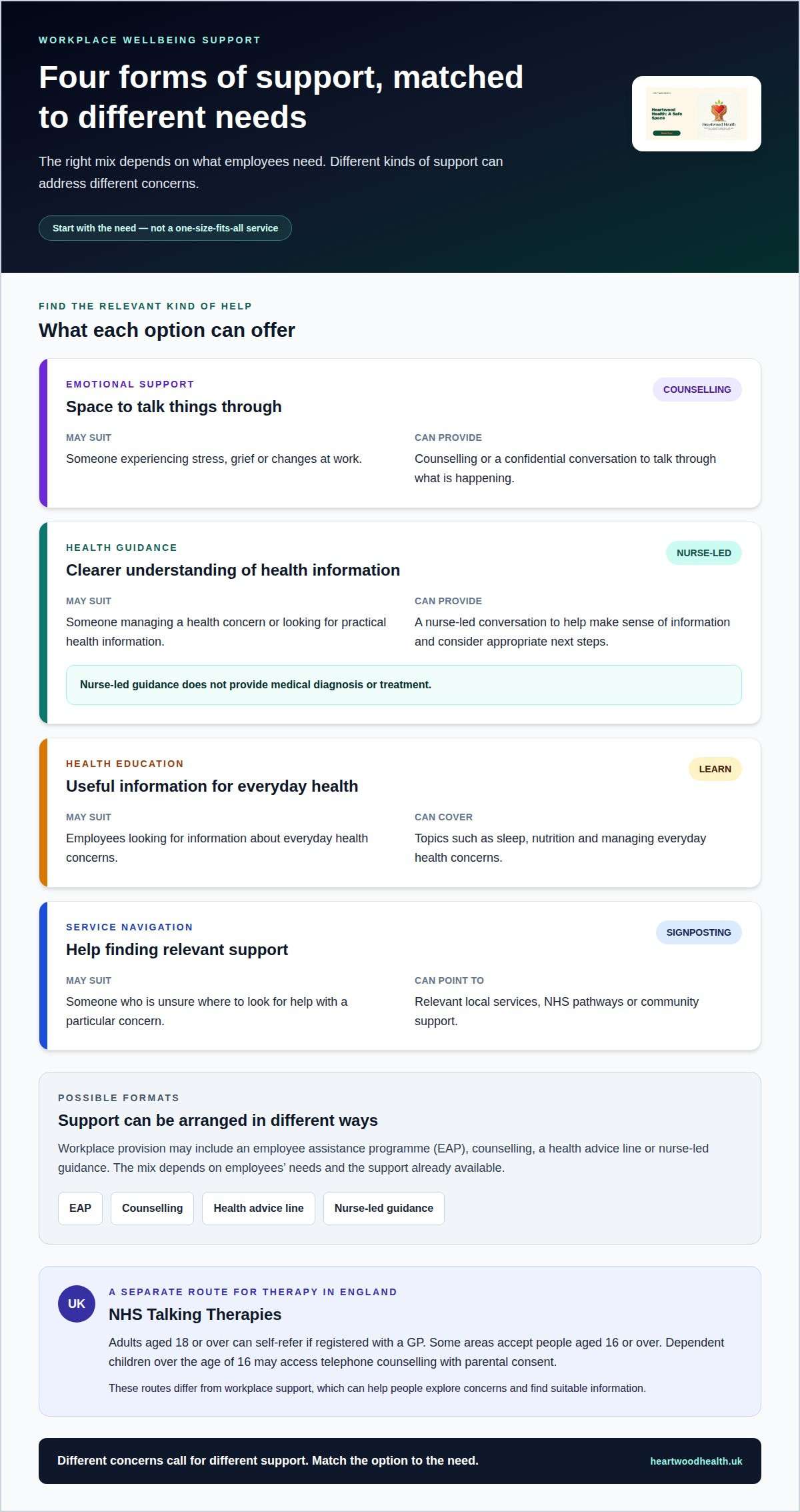
In the UK, workplace wellbeing support can cover emotional wellbeing, everyday health questions and practical help finding services. The right mix depends on employees’ needs. Someone experiencing stress may value a confidential conversation, while a colleague managing a health concern may need clear information and signposting. Support can include an EAP, counselling, a health advice line or nurse-led guidance.
Common forms of support address different needs:
- Emotional support: Counselling or a confidential conversation can give someone space to talk through stress, grief or changes at work.
- Health guidance: A nurse-led conversation can help someone understand health information and consider appropriate next steps. It does not provide medical diagnosis or treatment.
- Health education: Clear resources can explain topics such as sleep, nutrition or managing everyday health concerns.
- Service navigation: Signposting can help employees find relevant local services, NHS pathways or community support.
For therapy in England, adults aged 18 or over can self-refer to NHS Talking Therapies if registered with a GP. Some areas accept people aged 16 or over. Dependent children over the age of 16 may access telephone counselling with parental consent. These routes differ from workplace support, which can help people explore concerns and find suitable information.
Start by matching the type of support to the need. An employee seeking practical health information may benefit from nurse-led guidance, while someone wanting to discuss emotional concerns may prefer another form of support. Confidential conversations, information and signposting can serve different needs without treating every concern as the same.
What to expect from a wellbeing consultation
A wellbeing consultation can give you space to explain a concern in your own words, whether it involves work-related stress, disrupted sleep, caring pressures or uncertainty about a health issue. A nurse-led conversation can help you clarify what matters to you and consider possible next steps.
Use the conversation to consider how the concern affects daily life and what kind of support feels relevant. You may want health information, a confidential space to talk things through or help understanding possible support routes. Share only what feels comfortable and keep the discussion focused on what you need.
A consultation may explore areas such as:
- Your main concern: What has changed, what is troubling you and what you would like help with.
- Everyday impact: Whether the issue affects sleep, work, family life or your sense of wellbeing.
- Support options: Whether health education, confidential wellbeing support or signposting could be relevant.
- Your next step: What information or type of support would help you move forward.
Nurse-led wellbeing support can offer a calm space to discuss health questions and understand available options. It is different from medical diagnosis or treatment. If your concern needs clinical assessment, the consultation can help you recognise that distinction and consider an appropriate route for clinical care.
You don’t need to have a clear solution before a consultation. A useful outcome may simply be a better understanding of your concern, the support you’re seeking and the questions you want answered. That clarity can help you decide whether ongoing guidance, health resources or another form of support fits your situation.
A free 10-minute introductory call
A free 10-minute introductory call offers a brief, low-pressure way to talk about confidential nurse-led wellbeing and health support. You can describe what has prompted your enquiry and explain the kind of guidance you’re looking for. You don’t need to have every detail worked out before the conversation.
If you’ve been unsure whether this kind of support fits your needs, use the call to ask practical questions. You might want to understand how nurse-led guidance differs from medical diagnosis or treatment, or explain whether you’re seeking help for yourself, a family member or a workplace. The conversation helps you get a clearer sense of the support being discussed.
Callbacks can be arranged at a time that suits you. That can make it easier to find a moment when you’re able to speak privately and give the conversation your attention. If you’re arranging a call around work or caring responsibilities, you can share a suitable time for the callback.
You could use the short call to raise points such as:
- Your reason for enquiring: Share the concern or question you’d like to discuss.
- The type of support you need: Explain whether you’re looking for health guidance, wellbeing support or help understanding your options.
- What happens next: Ask how a further conversation or ongoing support could work for your situation.
The call is an introduction, not a substitute for a clinical assessment. It can help you decide whether confidential nurse-led support feels relevant before considering a longer conversation. You’re welcome to ask questions in your own words and take time to consider what you hear. A calm first conversation can make the next step feel clearer, without requiring you to make a decision on the spot.
Finding health advice and local support
Finding relevant support starts with identifying what you need help with. You may be looking for clear health information, emotional support or a local service that understands a particular concern. The right route depends on the kind of help you’re seeking and where you live, as local services can differ across the UK.
For a concern that needs clinical attention, consult your GP or health provider. For practical guidance or help understanding available options, confidential, nurse-led wellbeing support can offer information and signposting. It does not provide medical diagnosis or treatment.
When exploring local support, these details can help narrow the options:
- Your main need: Describe the question or concern, such as support with emotional wellbeing or understanding a health topic.
- Your location: Your area can shape which local services and community resources are relevant.
- The kind of help you’re seeking: Consider whether you need information, a conversation or a service with a specific focus.
Health advice can also help you make sense of what to do next. A nurse-led conversation, for example, may help you organise your questions and understand possible support routes. If you’re looking for a local service, clear signposting can make the search feel more manageable by helping you focus on services that relate to your needs and area.
If someone is experiencing an immediate mental or physical health crisis, call 999. For other concerns, the key is choosing a route suited to the type of help needed. You can then consider whether local services, health information or confidential wellbeing support offers the most relevant next step.
Heartwood Health: Confidential nurse-led wellbeing and health support
Heartwood Health provides confidential, nurse-led wellbeing and health support for individuals and businesses. It may suit you if you want a supportive conversation about wellbeing or health questions and help making sense of possible next steps.
You can talk through what feels difficult, explore relevant health information and consider possible next steps. You might want guidance about a health concern or a clearer sense of what wellbeing support could suit your situation. The conversation can help you identify the questions and topics you want to explore.
For businesses, confidential, nurse-led support gives employees another way to discuss wellbeing and health questions. It can be offered alongside an existing EAP, through local visits or fully remote sessions. Begin with the concerns employees want help with rather than assuming everyone needs the same support.
- For personal concerns: Talk through health or wellbeing questions in a confidential setting.
- For workplace needs: Consider whether nurse-led support could complement existing employee support.
- For next steps: Explore relevant information and support options with a nurse.
Heartwood Health provides wellbeing and health support, not medical diagnosis or treatment, prescribing or emergency care. If you need clinical assessment, consult your GP or health provider. For non-emergency questions where you want confidential guidance, nurse-led support may be relevant.
If you’d like to discuss whether this support suits your needs, contact Heartwood Health when it feels right for you.
Frequently Asked Questions
What workplace wellbeing support options are available in the UK?
Workplace arrangements depend on the support a business wants to offer and how employees will access it. Consider whether your priority is individual guidance, support for a particular group or provision across the workforce. These needs help define an arrangement that fits your organisation.
How can you choose an employee wellbeing programme?
Employee wellbeing programmes don’t follow one standard format. Some focus on a specific workplace need, while others bring different forms of support together. To understand what a programme offers, consider who it is intended to support, how employees can access it and whether it complements existing arrangements. These details give you a clearer basis for assessing its relevance to your organisation.
How should workplace wellbeing support reflect employees’ needs?
The scope and delivery format of workplace support should reflect employees’ needs. A business seeking individual guidance may need a different arrangement from one addressing a particular wellbeing concern. Consider what support is included and how it will work alongside existing provision.
What should you check before choosing a wellbeing support provider?
Look at the provider’s approach, who will deliver the support and whether its format suits your employees. Clarify how people access the service, how confidentiality is handled and what the support can help with. For instance, a workforce with varied needs may value clear information about available support routes. Also consider how the service could sit alongside arrangements your organisation already has.
What support options might a UK wellbeing provider offer?
Workplace support may include an EAP, counselling, a health advice line or nurse-led guidance.


